Your skin is losing collagen right now. Starting in your mid-20s, the human body produces roughly 1% less collagen per year, and by the time most people notice the signs, they’re already years into the decline.
The good news: light can reverse the direction of that process. Not just slow it. Reverse it.
Red light therapy for collagen production has moved well beyond wellness trend territory. It is one of the most research-backed applications of photobiomodulation (PBM), with controlled clinical trials demonstrating measurable increases in intradermal collagen density across a range of patient populations. Whether you’re a practitioner looking to offer a clinically credible anti-aging protocol, a facility owner looking for a high-value service, or someone managing your own recovery and longevity, understanding the mechanism behind this is what separates informed decisions from marketing noise.
Here’s exactly what happens when red light meets skin.
TL;DR:
- Red and near-infrared light penetrates the skin and energizes mitochondria inside fibroblast cells
- This triggers increased ATP production, activating fibroblasts to synthesize more collagen
- Red light also suppresses the enzymes that break collagen down — building more, losing less
- Clinical trials confirm measurable increases in intradermal collagen density, reduced wrinkle depth, and improved skin elasticity
- Results are gradual and require consistency — most patients see meaningful changes at 4–12 weeks
- Wavelength, power output, and exposure area determine whether a device actually delivers results
What Collagen Actually Does (And Why We Keep Losing It)
Collagen is the structural protein responsible for the skin’s firmness, elasticity, and resilience. It accounts for roughly 70–80% of the skin’s dry weight and is produced primarily by fibroblasts, specialized cells that live in the dermis, the deeper layer of skin beneath the surface.
The problem is that fibroblast activity declines with age. Slower fibroblasts mean less collagen being built and more being broken down by enzymes called matrix metalloproteinases (MMPs). The result: thinner skin, reduced elasticity, and the visible signs of aging.
External factors like UV exposure, poor sleep, chronic inflammation, and oxidative stress accelerate this process. For many of your patients, the decline is happening faster than biology alone would predict.
This is where red light changes the equation.
How Light Activates Fibroblasts at the Cellular Level
Red light therapy for collagen production works through a well-characterized cellular process called photobiomodulation.
Here is the sequence:
- Photon absorption: Red (630–660 nm) and near-infrared (810–850 nm) wavelengths penetrate the skin and are absorbed by cytochrome c oxidase, a photosensitive enzyme in the mitochondria responsible for cellular energy production.
- ATP production increases: This absorption triggers increased mitochondrial activity, producing more adenosine triphosphate (ATP) — the cell’s primary energy currency.
- Fibroblasts activate: Energized fibroblasts upregulate their collagen synthesis activity. Research published in the Journal of the American Academy of Dermatology confirmed that exposure to red and infrared LED light increased synthesis of collagen protein, elastin protein, and hyaluronic acid in human fibroblasts, with gene expression results visible within one week of daily exposure.[1]
- Collagen degradation slows: Red light also inhibits MMP expression — the enzymes that break collagen down. A 2025 study published in PubMed found that red light activated AKT signaling in fibroblasts, which suppressed MMP expression via the NRF2/HO-1-dependent pathway, reducing collagen degradation while simultaneously amplifying production.[2]
The net effect: more collagen being built, less collagen being destroyed.
What the Clinical Evidence Actually Shows
The mechanistic research matters, but controlled human trials are where practitioners and facility owners should look for confidence.
The most-cited controlled trial on this topic is the Wunsch & Matuschka study (2014), published in Photomedicine and Laser Surgery with 136 volunteers. Subjects received twice-weekly sessions of red light (611–650 nm) over 30 sessions. The results were statistically significant: treated subjects showed measurably improved skin roughness, increased intradermal collagen density confirmed by ultrasound, and visible wrinkle reduction assessed by blinded clinical photography.[3]
A separate split-face, double-blind study found that patients treated with 633 nm and 830 nm light experienced a 36% decrease in wrinkle depth and a 19% increase in elasticity, with histological analysis confirming an increase in collagen and elastic fibers in treated skin.[4]
These are not anecdotal outcomes. These are histologically confirmed, instrument-verified results from randomized controlled trials.
The consistent finding across studies: results are gradual and require consistency. Most patients see meaningful changes at 4–12 weeks of regular sessions. That timeline is a feature, not a flaw. It reflects real biological remodeling, not a surface effect.
Full-Body vs. Targeted: Choosing the Right Approach for Your Patients
Not every collagen concern is the same, and the delivery method matters.
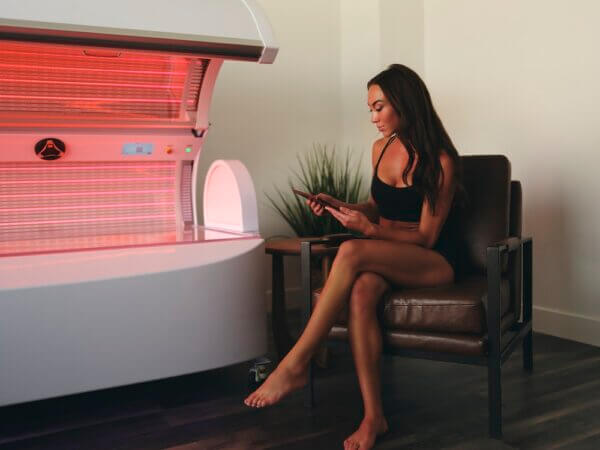
For patients seeking full-body skin rejuvenation, anti-aging, post-inflammatory healing, or systemic recovery, TheraLight red light therapy beds deliver whole-body photobiomodulation at clinically validated wavelengths. A single session exposes the entire body to red and near-infrared light simultaneously, making it practical for busy patients and scalable for facilities looking to offer high-value recovery and wellness services.
For targeted applications such as a specific joint, a localized injury site, or a problem area a patient wants to address at home or on the go, TheraGo provides professional-grade red light therapy in a portable format. Practitioners use it as a complement to in-clinic care; athletes use it to maintain recovery between sessions; patients use it to extend the work done in the clinic.
Both devices are built on the same principle: clinically validated wavelengths, correct power output, and consistent exposure. These parameters are non-negotiable. A device that doesn’t deliver the right wavelength at the right intensity won’t stimulate the cytochrome c oxidase pathway. And without that, the collagen response doesn’t happen.
How to Talk to Patients About Red Light and Collagen
The patients most receptive to this conversation are those who:
- Are asking about anti-aging treatments and want non-invasive, evidence-based options
- Have chronic inflammation or skin conditions slowing their healing
- Are post-procedure (surgery, injury) and want to accelerate tissue remodeling
- Are high-performance individuals focused on full-body recovery and longevity
When explaining the mechanism, keep it simple: “Red light energizes the cells responsible for making collagen. Over consistent sessions, those cells produce more collagen and break down less of it. The research confirms it works. You just have to give it time.”
That framing respects your patient’s intelligence, sets accurate expectations, and positions the treatment as science-backed rather than wellness-adjacent.
For facilities, this is also a service with strong retention mechanics. Patients need regular sessions to maintain results, which creates repeat visits, recurring revenue, and a built-in reason to keep coming back.
The Takeaway
Red light therapy for collagen production is not a trend with a research problem. It is a clinically validated application of photobiomodulation with a clear mechanism, consistent human trial data, and outcomes that practitioners can measure and patients can see.
The key variables: correct wavelengths (630–660 nm for surface; 810–850 nm for deeper tissue), adequate power output, sufficient session frequency, and time.
If you’re evaluating how to add red light therapy to your practice or facility, or you want to recommend a professional-grade at-home option to patients, the place to start is with devices built on the right science.
Explore TheraLight and TheraGo to see how Aspen delivers photobiomodulation at the clinical standard your patients deserve.
Sources:
[1] Low-level red and infrared light increases expression of collagen, elastin, and hyaluronic acid in skin. Journal of the American Academy of Dermatology, 2019. https://www.jaad.org/article/S0190-9622(19)33160-3/fulltext
[2] Red light promotes dermis-epidermis remodeling via TGFβ and AKT-mediated collagen dynamics in naturally aging mice. PubMed, 2025. https://pubmed.ncbi.nlm.nih.gov/40808593/
[3] Wunsch A, Matuschka K. A Controlled Trial to Determine the Efficacy of Red and Near-Infrared Light Treatment in Patient Satisfaction, Reduction of Fine Lines, Wrinkles, Skin Roughness, and Intradermal Collagen Density Increase. Photomedicine and Laser Surgery. 2014;32(2):93–100. https://pmc.ncbi.nlm.nih.gov/articles/PMC3926176/
[4] Lee SY, et al. A prospective, randomized, placebo-controlled, double-blinded, and split-face clinical study on LED phototherapy for skin rejuvenation: clinical, profilometric, histometric, ultrastructural evaluation of human skin structure and function. Journal of Photochemistry and Photobiology B: Biology, 2007.